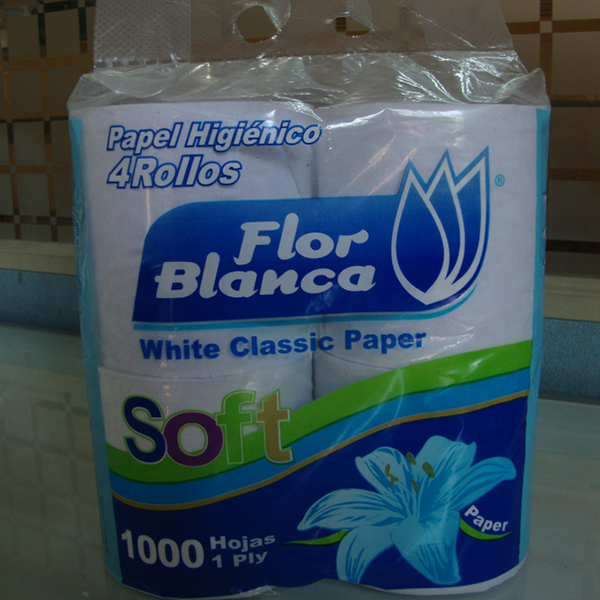
The cost of pulp accounts for nearly half of the cost of household paper products and remains at a high level. Pulp costs account for a high proportion of the cost structure of the household paper business. Taking Vinda International as an example, according to our estimation, pulp costs accounted for 51% to 70% of the total cost of its household paper business from 2015 to 2021. According to the 2020 annual report of Zhongshun Jierou, the cost of pulp accounts for approximately 40% to 60% of the company's production cost.
The fluctuation of wood pulp prices has an inverse relationship with the company's gross profit margin and net profit margin. We judge that this is mainly influenced by two aspects: 1) The price of wood pulp has a certain periodicity; 2) Household paper is a 2C product, and the terminal price is relatively stable.
Looking back, the period from 2018 to 2020 was a downward cycle for wood pulp prices. Within two years, the price of coniferous pulp dropped from 6,795.9 yuan per ton to 4,714.0 yuan per ton, a decrease of 30.6%, and the price of broad-leaved pulp decreased from 5,726.9 yuan per ton to 3,625.5 yuan per ton, a decline of 36.7%. Meanwhile, in 2020, the gross profit margins of Vinda International's household paper business and Zhongshun Jierou reached 38.3% and 41.3% respectively, increasing by 10.7 percentage points and 7.2 percentage points respectively compared with 2018. As of May 2021, the price of wood pulp continued to rise, reaching a high level and then falling continuously in the second half of the year, effectively reducing the cost burden of the household paper business and having a positive impact on the profit situation of papermaking enterprises.
In 2022, new wood pulp production capacity is expected to be put into operation, and the high pulp price is likely to ease. The new supply of wood pulp is expected to gradually come on stream. Since 2012, the global supply of wood pulp has remained relatively stable, but this pattern is expected to be broken in 2022. The main reason is that the production capacity of broadleaf pulp is expected to increase significantly. The facilities in Bracell, Brazil and MAPA, Arauco, Chile were put into operation at the end of 2021, with a combined annual capacity of 4.1 million tons. Meanwhile, the new UPM facility in Uruguay is also scheduled to be operational by mid-2022, bringing an annual capacity of 2.1 million tons. As the pulp and paper industry is a capital-intensive sector, the capacity construction period is relatively long. Therefore, once capacity construction begins, the sunk cost is high and "difficult to reverse". Compared with 2020, it is estimated that the global broad-leaved pulp capacity will increase by 6% and 5% respectively in 2022 and 2023, and is expected to grow by 19% by 2025. The capacity of coniferous pulp is expected to grow steadily, with an average annual growth rate of less than 1% from 2020 to 2025. This is mainly due to the fact that no new facilities have been put into operation and the old facilities are close to full capacity. It is estimated that the operating rate of softwood pulp facilities will be nearly 92% in 2022.
From the demand side, the new global demand for wood pulp mainly comes from China, including cultural paper, white card paper, and household paper, etc. We believe that under the trends of paperless office, electronic teaching and online media, the overall demand for cultural paper is expected to gradually decline. Taking double-coated paper as an example, the apparent consumption of double-coated paper only achieved a compound annual growth rate of 1.4% from 2009 to 2020. White card paper is used in downstream packaging. Since 2017, the growth rate of its consumption has slightly declined. From 2017 to 2020, the compound annual growth rate was 3.9%, which is in a stage of slow growth. The consumption of household paper has shown a stable growth trend, with an average annual compound growth rate of 7.5% from 2009 to 2020. From the perspective of the demand segment, no significant growth-driving factors have emerged.
Tag: 11